
 Deutsch
ROVER 200 Mark I
213 / 216 - Development
1984 - 1989
A few weeks after the successful launch of the Triumph Acclaim - a Honda Ballade with a different company logo - in the UK, contracts were negotiated between Rover and Honda for two further joint projects. The agreements were approved in November 1981. The Triumph Acclaim should be replaced by the successor of the Honda Ballade , which was planned for 1984. This should have a class positioned above the Acclaim .
Since the car division of British Leyland was now Austin-Rover and the name Triumph was dying after the TR 7 was released, it was decided to introduce the new car under the name Rover .
Mark Snowdon was very impressed with the plan: "Our company is called Austin-Rover. People don't associate the name Triumph with the other two. This was partly confusing on the European market, especially as we are starting quite well there. We also believe that the name Rover goes much better with a small luxury car - Triumph is always associated with the inexpensive, sporty roadster - and we don't want that".
However, this strategy of combining such a prestigious name with a small car was also risky: it was feared that the name Rover could be downgraded to the cheap segment. But Austin-Rover was convinced that the new car would maintain its high image.Unlike Acclaim there was enough time to develop the new car. In the first step, space had to be created for the engine of the "S" series. Due to the higher weight, the future rover required a stronger machine in order to be able to appear as a viable alternative on the fleet market. Rover wanted to reposition itself here after the Acclaim had never become an important company car. Only 26% of its registrations were for company fleets. Incredibly little for a "British" middle-class car.
The new model should clearly show the Austin-Rover signature and have a British interior. Rover actually succeeded in getting this through.
The closer the production acceptance, the more intensively customers were asked about the new "small Rover". Sales and marketing strategies were very strongly geared to customer needs. Rover used the Ford Orion as a comparison vehicle. For a good reason: the Orion was basically a Escort with conventional boot, at the same time positioned "exclusive" above the Escort by better equipment. In many areas the rover would compete directly with the Orion. The use of the name Rover was seen positively by potential customers, as Snowdon also confirmed: "Of all the positive brand names, "Rover" was the best fit for the new model.
Numerous considerations were made during the naming process. The name had to match the existing SD1 as well as the planned XX model (800). Traditionally Rover had never used names for his models, but always preferred numbers. Following this logic, the new car could be called Rover 1300 or Rover 1600. But after careful consideration they came to the conviction to let the models run under a common name. One of the reasons was that this had led to success at BMW - so they decided to call it the "200 series". The 1300 ccm version should be called "213" and the 1600 ccm version "216".
As with Rover's unfortunate tradition, not all models were available at the market launch in June 1984 - the models with S Series engines (216) followed a year later.
Technically, the car was a real Honda, but unlike the Acclaim, the Honda Civic fitted better into its European environment. The wheelbase had grown by 5.5 inches (approx. 14 cm). The footwell benefited from this, and the interior redesigned by Austin-Rover gave the car a higher quality ambience. And Austin-Rover pointed this out repeatedly and with pleasure in all marketing campaigns - and rightly so.
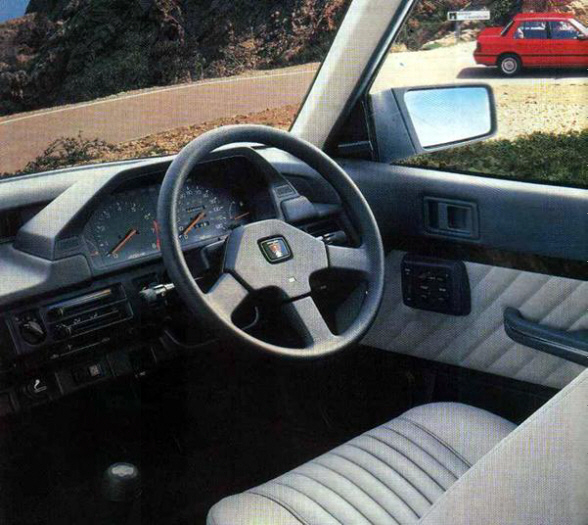 The interior of the 213 Vanden Plas, as advertised in the advertising campaign for the launch: emphasis was placed on the exclusivity of the product. This worked, as the car could quickly set itself apart from the Maestro and Montego models in decline in the minds of those interested. But the car was simply too expensive for many potential buyers.
The engine of the Rover 213 was one of the most advanced ever used in an Austin Rover/BL/BMC car. The Tokyo-designed 1,342 cc - 12-valve cross-flow engine was praised on all sides. And the construction concept ensured low fuel consumption with high performance potential. Thanks to its all-aluminium construction the engine was light and because of the cylinder arrangement ("Siamese twins") also short. 70 bhp at 6,000 rpm (as with the Acclaim) and a maximum torque of 75 lb ft at 3,500 rpm (higher than with the Acclaim) were a good yield.
Austin-Rover made minor modifications to the suspension system to improve performance.
In June 1984 the car was introduced. The press had expected a Triumph - apart from that the 213 found great approval.
The Car Magazine wrote: "Inside, the 213 is a reverence to British. Seats and upholstery are as British as beer after work or roast beef on Sundays. The SE and Vanden Plas models are particularly impressive. Both are furnished with walnut wood on the doors."
Japanese ergonomics in combination with British wood and leather - an increasingly interesting topic in the Hondas revised by Rover. And Honda learns a lot from Austin Rover about dashboard design and interior ambience.
The first driving impressions were very good, but during longer journeys the limits of the chassis became visible. "Driving comfort has never been the strong point of the rear-wheel-drive SD1 with rigid axle. And although the concept of the Rover 213 Vanden Plas is completely different, it is fair to say that driving comfort is not the strongest side of this baby Rover either," remarked Autocar. And Motor wrote: "The handling of the Rover 213 is not bad, but according to our testers the handling is worse than the Honda Civic and worse than the Maestro and Montego".
In May 1985 the 1.6-litre models of the Rover 200 - called "216" - appeared. The S Series engine could hardly compete with the silky smooth running Honda 12 valve, but it performed adequately. Unlike the Maestro and Montego models equipped with the S Series engine, the 216 retained the Honda transmission found in the 2-litre Austin and MG Maestro/Montego models. This was a good thing, because the models equipped with VW transmissions were perceived as choppy and were considered less reliable - but fleet managers were assigned to the drive shafts of Austin-Rover. The company did not risk losing the Rover 200's reputation as a reliable vehicle.
Rover took the opportunity to demand more far-reaching changes in suspension and damping - something Honda didn't really want. However, solutions had to be found for the driving disputes. Frequently criticized were the pounding of the car during strong acceleration and the rolling during cornering. However, the spring travel felt to be too short was due to the design and could not be changed.
The solution offered by Honda worsened the handling; Rover of course did not want to accept this. This is how the chassis developers of ROVER took care of the matter. They quickly succeeded when they noticed that there was a 17% difference between the right and left rear axle springs. After Austin-Rover fixed this, the handling and handling were back to the level of the car class. Honda adopted the change in its vehicles, not just those built in Longbridge.
The Rover 200 benefited greatly from further development work. He became more and more popular with age. In addition to the carburettor models of the 216, there were now the EFi models with Lucas single point system, which were available in luxurious Vanden Plas and sporty Vitesse equipment.
In 1987 the successor of Rover 213/216 - known as "AR8" - was already on the drawing boards after the name of the development program "YY" was dropped in 1986.
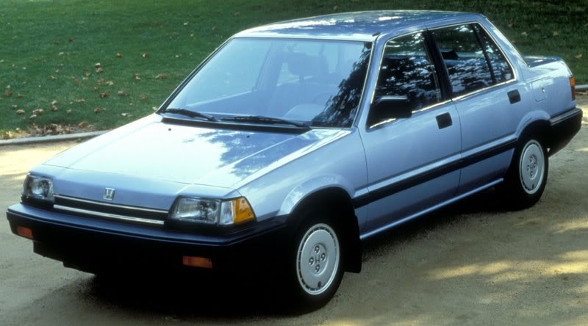
For comparison: Honda's parallel development "Civic" 1985.
© 2021-2026 by ROVER - Passion / Michael-Peter Börsig