
 Deutsch
ROVER 200 Mark I
213 / 216 - Tests and Reports
1984 - 1989
Last Rescue?
Driving report on the Rover 213 in "Auto, Motor und Sport"(Germany), issue 14, 1984 (excerpts)
Original Title: Letzte Rettung? "What used to be called Triumph Acclaim and was a Honda Ballade is now called Rover. Because that sounds, as market researchers undoubtedly found out, even better. Since the Honda Ballade was due for a model change, the opportunity to change the name was good. The Honda alias Rover not only looks different from its predecessor, the Triumph brand, it also has a number of technical improvements to offer, all in keeping with its new upscale status." "The Austin Rover engineers have refined the whole thing a little - especially with regard to the rather uncouth ride comfort of the Japanese original. The focus was on a more effective containment of the Honda's distinct noise and vibrations from the engine compartment, which was achieved by a modified structure of the body stem and modified engine mounts. The British were not entirely satisfied with the suspension either, and gave the Rover version a softer suspension tuning." "The latest production methods and an army of robots are to make the company's inglorious past forgotten in terms of quality.“ "Seats, carpets and parts of the door trim were, as one proudly notes, created not only in production, but also in design on British soil. The top version, Vanden Plas, even had dry root wood strips attached to the doors on the inside - a rather grotesque gesture to the English car tradition here." "The space available in the rear seats is rather limited, which requires a generous willingness to compromise on the part of the occupants when using the rover as a four-seater touring car. Light luggage is recommended, as the loading edge of the luggage rack is very high." "But the fact that the Rover is not exactly one of the temperamental sedans of the lower middle class is also due to the engine. The acceleration seems tough, the power development beyond 4500 rpm breathless, and the gear ratios in the gears seem rather too long in view of the lean power reserves." "The new edition of the Acclaim should therefore not fall on fertile ground, at least in this country - not even when the prestigious name Rover is used for it." |
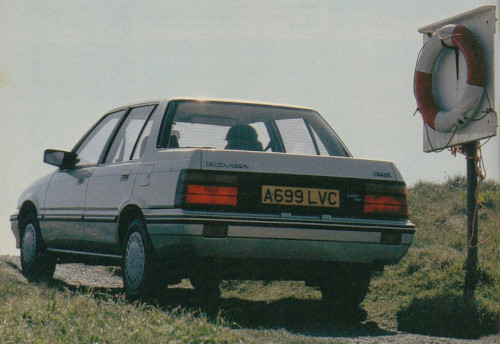 Rear view of the Rover 213 Rear view of the Rover 213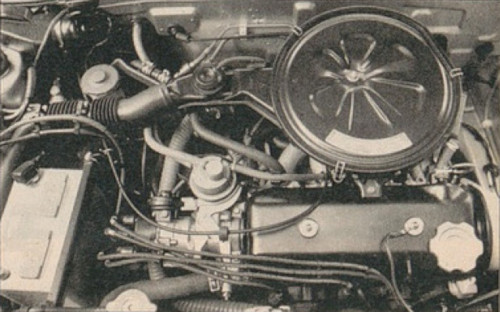 Engine of the Rover 213 - 1.3-litre four-cylinder from Honda Engine of the Rover 213 - 1.3-litre four-cylinder from Honda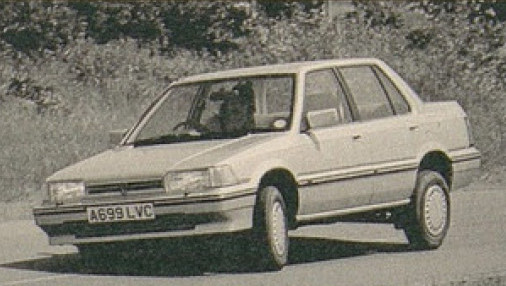 When cornering fast, the Rover 213 tends to oversteer. When cornering fast, the Rover 213 tends to oversteer. |
Two Lively English Cars
Description of the Rover 216 in "Automobil Revue" (Switzerland), issue 18, 1985 (excerpts)
Original Title: Zwei temperamentvolle Engländer "In the case of the Rover, which is now supplemented by the more powerful Model 216, however, the domestic English share is up to a respectable 83%, for some versions up to 88%. While, for example, the entire drive block of the 213 (1342 ccm), like other parts, is also shipped from Japan, the 1.6-liter engine of the new 216 comes from our own production, and for the 216 Vanden Plas EFi Automatic the gear factory Friedrichshafen figures as the supplier for the four-speed automatic.“ "With the more powerful engine, the 'small' Rover - not available in Switzerland - develops more and more into an independent type, although the relationship to the corresponding Honda model remains.“ "The Austin Rover Group successfully covers the existing gaps in the mid-brand segment with interesting new developments". Note: The second vehicle described in more detail in this article is the MG Montego. The Rover 200 series was not available in Switzerland at the time of this writing. |
It's All Rover Now
Test of the Rover Series 200 in "Auto, Motor und Sport" (Germany), issue 19, 1985 (excerpts)
Original Title: It's all Rover now Note in advance:Contrary to the driving report in ams 1984/14, the series is certified as having a "spacious interior". "The cars produced on Leyland assembly lines are of mixed construction: The main body groups were delivered from Japan, with chassis parts and details such as fittings from the Far East added. Everything is completed with 'original parts' from the British supplier industry." "For the entry-level 200 model, the Rover 213 S, the British even adopted a Honda engine: in the nominally weakest link of the 200 chain with 73 hp (54 kW), the 1.3 liter four-cylinder engine with three-valve cylinder head from Honda works as it does in the Civic 1.3 service. This light metal engine is complemented by grey cast iron representatives of English design: In the Rover 216 SE the 83 hp (61 kW) strong 1600 long-stroke engine operates, while in the Rover 216 Vitesse it even delivers 102 hp (75 kW) in injection boost". "The well-being in the three new Rover entrants nevertheless carries the same traits. The 200 interior is easy to board via large doors. The interior conveys a touch of noble grandeur - the feeling of space in the Rover 213, 216 and 216 Vitesse corresponds to that of much larger automobiles". "All three behave in a British reserved manner when driving, are neither too sporty and taut nor too comfortably sprung. According to Rover, the golden tuning centre results in a car that is easy to move and always provides information about the road and road conditions. The ride comfort is satisfactory and the body tilt does not take on any pronounced shape in fast cornering". "It is still customary in Germany's motorist circles to conduct research into the processing quality of cars from the island in particular. In the case of the Rover 200 series, reassurance can be reported: All three test cars had a decent quality standard, which was by no means a matter of course for vehicles of earlier Leyland generations". "Even if the originality of British vehicles should suffer - the shot of Japanese thoroughness and reliability does the 200 series from Rover particularly good.“ |
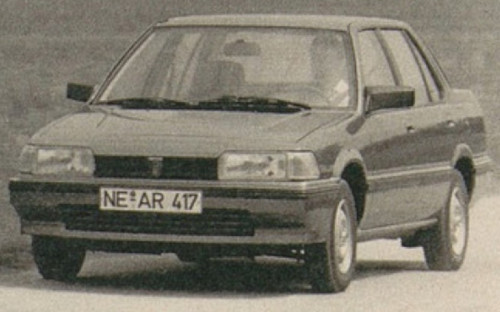 Basic model of the series - Rover 213 S Basic model of the series - Rover 213 S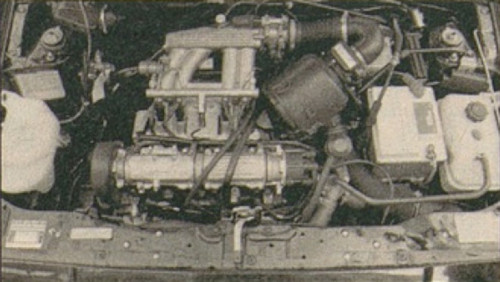 Engine of the Rover 216 Vitesse - 1.6-litre four-cylinder, from the Leyland rack, with Lucas injection system Engine of the Rover 216 Vitesse - 1.6-litre four-cylinder, from the Leyland rack, with Lucas injection system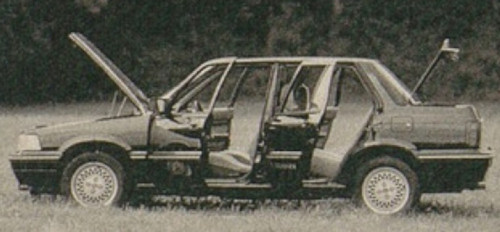 The boot lid is clearly visible, here before the facelift - very high loading edge. The boot lid is clearly visible, here before the facelift - very high loading edge. |
© 2021-2026 by ROVER - Passion / Michael-Peter Börsig