
 Deutsch
ROVER "Meteor"
20hp Weymann (Braunston) Tests and Reports
1930 - 1934
On 11 April 1931 The Motor published a test of the ROVER 'Meteor' Weymann Saloon. It describes the saloon and its characteristics very well, so we do not want to withhold it from you.
Road Tests Showing Principal Characteristics
The ROVER Meteor Saloon
A Refined, Moderately Priced, Well-equipped Car, Capable of High Average Speeds
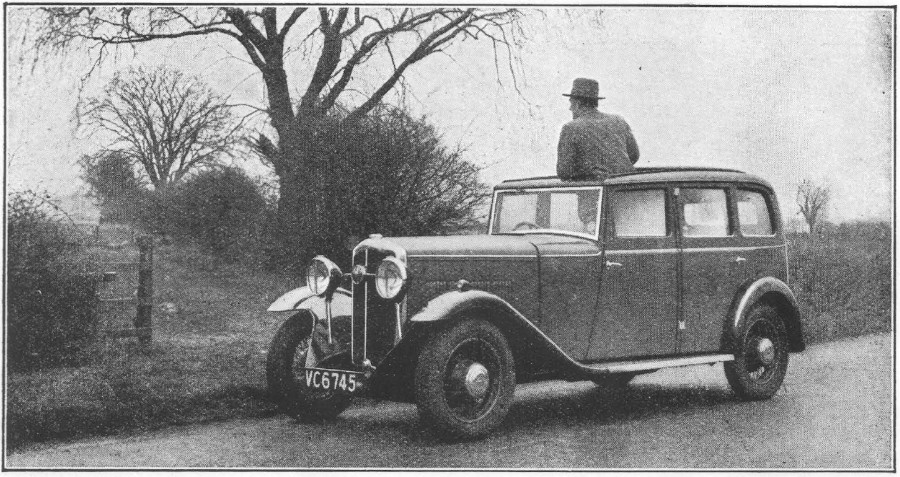 The Rover Meteor four-door Weymaun saloon with sliding roof has an imposing appearance and ls possessed of a splendid performance.
There is a subtlety about the design of the Rover Meteor which seems to connect appearance and performance. The flowing lines of the bodywork and the moderate height seem to suggest that it should be capable of a good turn of speed with power and smoothness as the predominating characteristics of the chassis. After a long week-end’s run in a Weymann saloon the foregoing thoughts were inspired and a high opinion was formed of the car from both a driver's and a passenger's point of view.
With a wheelbase of 9 ft. 10 ins. there is plenty of room on the chassis for a good-sized five-seater body to be installed, and still to leave space for a long bonnet and scuttle. Despite its moderate price of £398 the “Meteor” is thoroughly well equipped. The front seats are of the bucket type, both being adjustable. and, like the seats in the rear compartment, are upholstered in furniture hide. A sliding roof is included as a standardized fitment.
Mention should be made of the arrangement of instruments and controls. In the panel on the facia board is a clock, speedometer, petrol gauge, ammeter and an instrument which shows oil pressure and water temperature. Immediately beneath the facia are two small knobs, one of which operates the strangler and the other the starter; both are of the pull-out type. All the lighting controls are situated on top of the steering column.
No driver could fail to be impressed by the sweet-running qualities of the engine. Not only has an excellent state of mechanical silence been achieved, but “power roar” (that malady from which many modern highly eflicient engines suffer) has been almost entirely eliminated, this no doubt being due to the design of the induction manifold and carburetter air intake. The manifold itself has short branches and the air drawn into the carburetter passes through a filter, then into the overhead-valve chamber and along a pipe to the carburetter - an arrangement which unquestionably damps out a lot of noise.
Quiet Transmission
The transmission is equally quiet, and, while the clutch and gear controls possess that somewhat elusive characteristic of tautness, only slight pressure is required for application. In other words, the Meteor possesses all the characteristics of a high-grade chassis.
Although during our test weather conditions were far from favourable, engine starting proved to be an instantaneous matter, and, thanks to a hot-spot formed at the junction of the inlet and exhaust manifolds, the unit warms up to its normal working temperature quite quickly. Engagement of the gears is a matter of supreme simplicity, and what is also very important in the case of a quiet-running engine is that they are commendably silent, especially the third ratio, the pinions of which have helical-shaped teeth.
The pedal pressure for the operation of the clutch is little greater than that required for the accelerator pedal, and the engagement is so smooth that one can move off in top on a slight up-grade without a tremor of any sort. On the car we tried the free member of the clutch did not stop quite so quickly as we should have liked, but no doubt this is a matter which adjustment would put right.
Another point with which we were very favourably impressed concerns the steering. Although the wheel movement is very light there is an entire absence of “sponginess," which makes it possible for high speeds over rippled road surfaces to be indulged with perfect safety; the car “goes where it is "put."
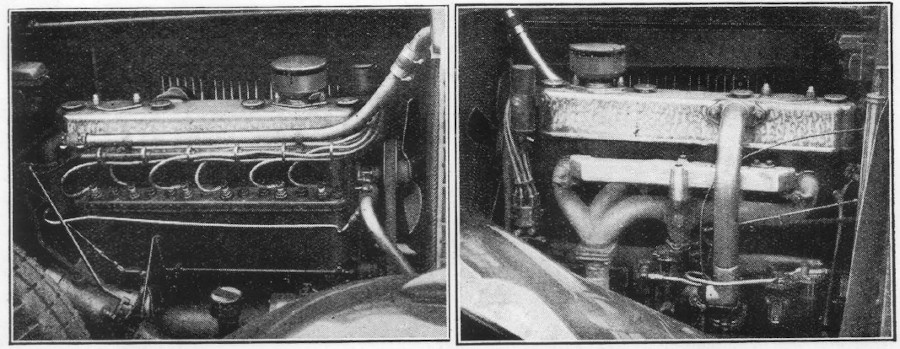 Two views of the six-cylinder o.h.v. power unit, showing the accessibility of the various components.
In traflic the engine evinces a marked liveliness which gives the driver an excellent opportunity of making the best of openings along a stream of slowly moving vehicles. Naturally, the “silent-third" speed comes in very handy, for to all intents and purposes the gear lives up to its title, and as will be seen from the performance curves the power unit has remarkable powers of acceleration at the low and middle ranges.
It is, however, on the open road where the car really comes into its own, for with the throttle about half-way open one can cruise at about 50 m.p.h. all day long if desired without the engine becoming in the least obtrusive. Even at its ninximum speed of slightly more than 65 m.p.h. there is remarkably little mechanical or thermal noise, the rush of the wind past the car almost drowning the engine note.
On level going one can accelerate (with two up) from 10 m.p.h. to 30 m.p.h. in 9 secs. and from 10 m.p.h. to 60 m.p.h. in 33 secs. - truly a fine performance for a car equipped with an engine of only 2½ litres. That it is not undergeared is testified by the fact that in favourable circumstances - i.e., with a slight down grade or with a following wind - a genuine 70 m.p.h. can be held; on level going 66 m.p.h. seems to be about the limit.
The effectiveness of the brakes is fully in keeping with the characteristic of speed. The pedal which applies internal-expanding shoes in drums attached to all four wheels does not require an unduly high pressure for a sharp pull-up.
In hilly country the Rover Meteor appears to be in its element. As the remarkably good acceleration figures indicate the car has exceptional top-gear hill-climbing powers.
Summing up, then, we formed a high opinion of this Rover Meteor saloon. Due to smoothly operating controls, it is a car which is not in the least tiring to drive, and, thanks to a highly efficient and silent engine, combined with good road-holding qualities in the chassis and good brakes, high average speeds can be maintained with perfect safety.
Chassis Details
Rover: Meteor Weymann saloon; six cylinders, 72 mm. by I05 mm. (2,565 c.c.). Tax £20. Overhead valves; coil ignition.
Gearbox ratios: 5.3, 7.69, 11.24 and 20 to l. Central control; "silent" third speed. Engine speed at 20 m.p.h. on top, 1,240 r.p.m.
Performance
Speeds on Gears: Top, 66 m.p.h. ; third, 48 rn.p.h.; second, 33 m.p.h. ; first, I9 m.p.h. Minimum speed on top gear, under 5 m.p.h.
Petrol Consumption: l6.7 m.p.g. under arduous conditions.
Acceleration: Standstill to 60 m.p.h., 31 secs.
| Brakes | Dimensions - Weight - Price | |
|---|---|---|
| Speed m.p.h. | Stop feet | |
| 10 | 7 | Wheelbase: 9 ft. l0 ins. - Track: 4 ft. 8½ ins. |
| 20 | 18 | Overall length, without bumpers: l3 ft. l0 ins. - Width: 5 ft. l0 ins. |
| 30 | 35 | Ground clearance: 7½ ins. - Turning Circles: 43 ft. in each direction. |
| 40 | 70 | Weight (unladen): 1 ton 8 cwts. |
| 50 | 125 | Price: With sliding roof, wire wheels and normal equipment, £398. |
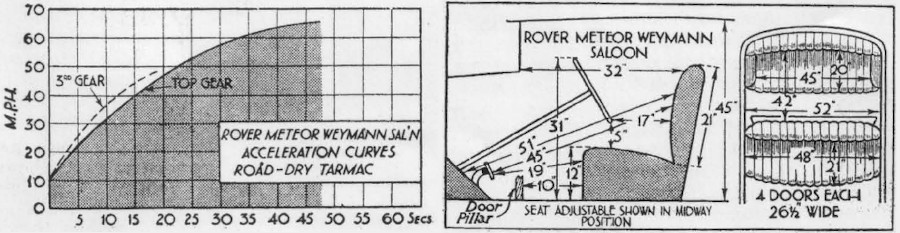
Acceleration Curves + Interior dimensions
Source: "The Motor", 11 April 1931
© 2021-2026 by ROVER - Passion / Michael-Peter Börsig