
 Deutsch
ROVER 'P2' 16hp Sixteen
Tests and Reports
1937 - 1940
On August 1938 the magazine 'The Motor' brings an extensive report about the ROVER 16hp 'Sixteen'. The report contains interesting details about the vehicle, which we are pleased to make available to you.
Rover 16 h.p. Saloon
A 2-litre Car Giving a Good Performance with Refined Running
"The Motor", June 7, 1938
If one had to pick a typically British car une could scarcely do better than choose the Rover Sixteen. This is not to say that it is an "average" car, for in many of its qualities it reaches a very high standard indeed, and, taken as a whole, it represents outstanding value for money at £360. It is, however, a car that is peculiarly British in its conception, running and manufacture.
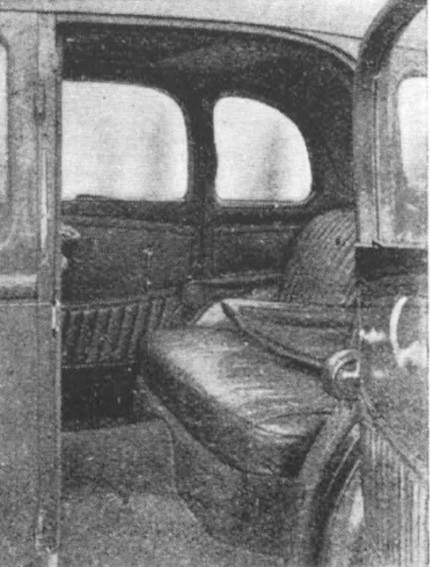
Considering these in this order, it will be noted from the body drawing that the driver and passengers sit in roughly the middle of the wheelbase, that there is a traditional length of bonnet between them and the radiator, and the rear passengers have ample legroom.
Simple Gear Changing
Thinking also of the chassis layout in the brouder terms, one finds that it has semi-elliptic springing with a six-cylinder, two-lítre overhead-valve engine and a four-speed gearbox. This last is the one point of design which smacks of the unconventional, for it is associated with a free wheel in the transmission and there is no synchronizing mechanism between the various ratios. With the free wheel in operation such expedients are, of course, not necessary, for gear shifting is simply a matter of pushing the lever from one notch to another at any speed, provided the throttle is closed.
So far as the running impression on the road is concerned, this has two aspects, one comparatively normal, the other exceptional. The car is normal in its acceleration, hill-climbing and maximum speed, although the latter, at nearly 78 m.p.h., is distinctly creditable, and the standing quarter-mile figure is also good. Figures, however, by no means tell the whole story of merit on the road, and this particularly applies in the case of the Rover Sixteen, for its qualitative, as distinct from quantitative, performance is unusual.
ln the first place, it is one of the quietest cars on the market irrespective of price. The current type of engine has been considerably improved in this direction, as compared with previous models, by improved design of the valve gear and other components. The rear axle is inaudible and although the gears can be heard on the indirect ratios, on top the car receives little or no evidence that this is a mechanically propelled vehicle.
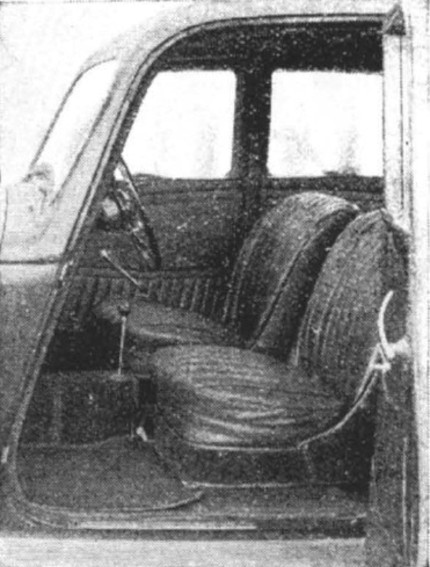 |
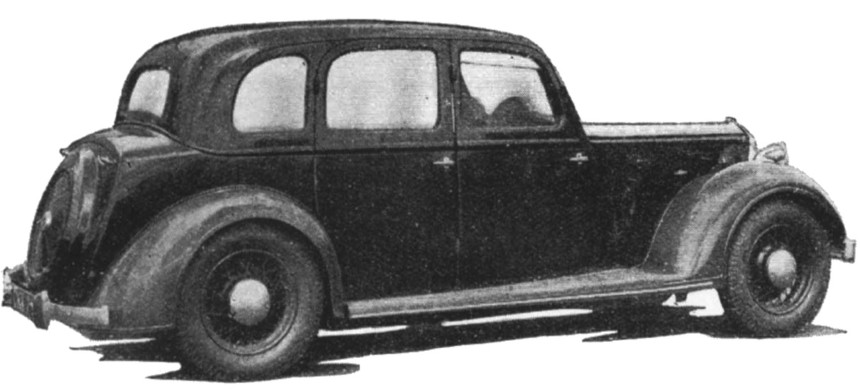 The ROVER 16hp Saloon, Model Year 1938 Left: View of the comfortable, wide and well-upholstered front seats |
 |
Reinforcing the care that has been taken in these directions is the fact that even at high speeds there is little wind noise around the body.
Speed Without Effort
The net result of these combined factors is that the car can be cruised quite comfortably at any speed up to 70 m.p.h., and one can drive with a remarkable absence of effort. Driving ease is, of course, closely bound up with the steering and suspension. On this car ultra-soft springing has been avoided and although, in consequence, one can feel road irregularities at the lower speeds, one gains considerably by having stability on bends that is thoroughly adequate for this type of saloon. The steering is light and has ample castor action. The road can be felt through the wheels so that control is live and one feels a direct connection between hand and road wheels. The freewheel transmission works out excellently in practice and there is a large knob on the facia panel enabling one to lock the transmission if one feels so inclined. In these circumstances, double declutching is, of course, necessary to obtain a quiet gear change, but there are no difficulties in this process and no tricks were needed to engage any ratio. A quiet change up from third to top did, nevertheless, involve some delay.
"Brakes by Girling” is a phrase which has come to be synonymous with smooth stopping and short pull ups. The Rover bore out this reputation, as will be seen from our brake test panel. There are many features of equipment and running which are
deserving of comment, but to do so would make it impossible to comment on certain features of the construction which are of particular value to the owner. In the first place the manufacturers go to a good deal of trouble to ensure that the exterior finish of the car is not only good as it leaves the works, but remains in excellent condition.
For this reason, with the exception of the bumper, all chromium-plated parts are made of brass so that rusting of the plate is virtually impossible. Similar attention is given to the mechanical parts of the specification. The engine, for instance, has a fully counter-balanced crankshaft, a feature that not only makes a useful contribution to smoothness, but also substantially reduces the loading on the main bearings and thus reduces bearing wear. The Rover Co. have, moreover, realized that chassis life is entirely dependent upon satisfactory and thorough lubrication, and they, therefore, provide a Luvax central chassis oiler which covers both stub axles, all shackles and other similar parts. The sliding joint on the propeller shaft, which is usually the Achilles' heel of these systems, is recessed into the gearbox and receives lubrication from the gear oil.
Finally, having taken all these precautions to ensure trouble-free running, one finds that, just in case, tools are mounted on an accessible rubber-lined tray immediately under the facia panel. One cannot help feeling that such a provision is proof beyond doubt of the thoroughly British character of this very likeable car.
The technical data attached to the preceding article have been transferred to the specifications page.
© 2021-2026 by ROVER - Passion / Michael-Peter Börsig